All Resources
Insights & Reports
State of MedTech w/ Magnus VP of Sales Matt Wallace and MedScout CEO Skylar Talley
Listen to the podcast now on Apple, Spotify, or watch on YouTube.
Listen to the podcast now on Apple, Spotify, or watch on YouTube.
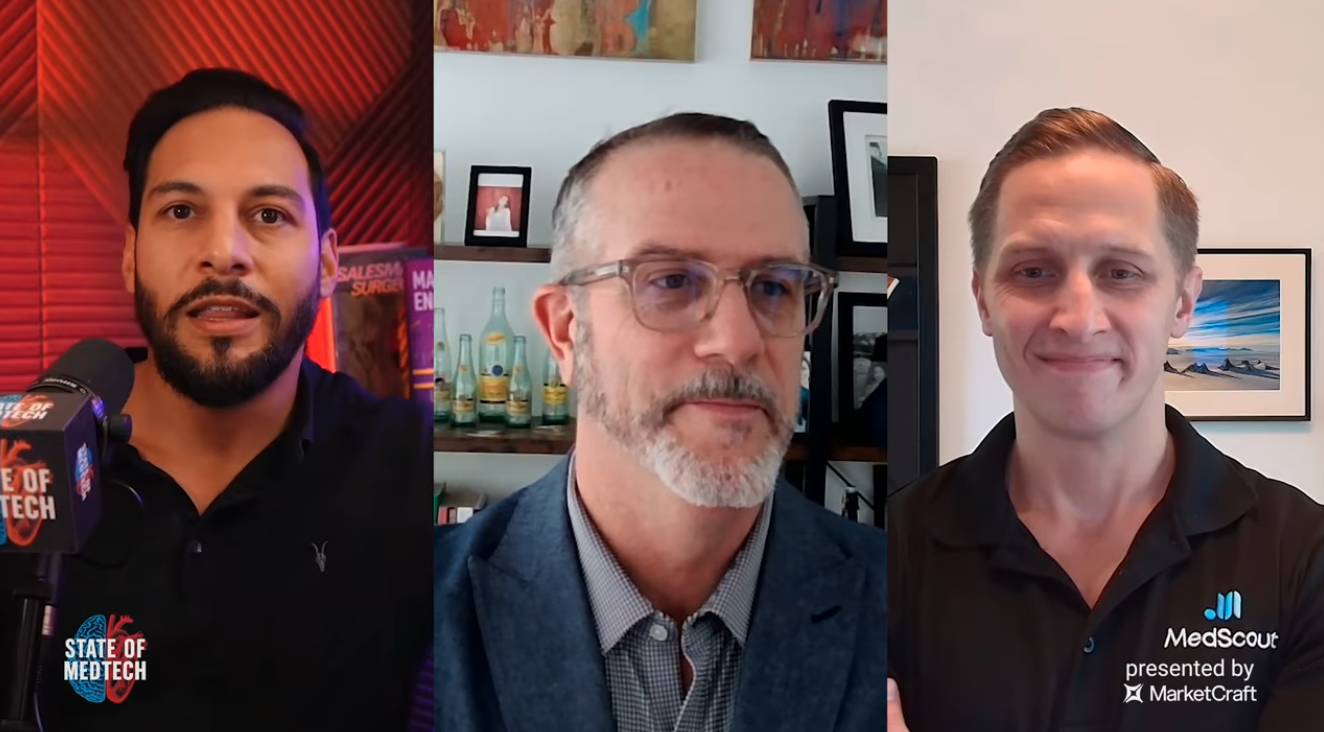
On a recent episode of State of MedTech, host Omar Khateeb talked with MedScout co-founder and CEO Skylar Talley and Matt Wallace, vice president of sales at Magnus. Matt and Skylar have worked together since 2023, when Matt was at Insightec selling focused ultrasound and continued at Magnus, where his team is building the market for a new depression treatment. The conversation covered how hiring reps has changed, what an AI workflow looks like in the field, and why software companies selling into medtech are starting to look more like services firms.
Magnus is the commercial arm behind SAINT (Stanford Accelerated Intelligent Neuromodulation Therapy), a protocol developed at Stanford for treatment-resistant depression. It uses TMS as the delivery vehicle, but the targeting, timing and staffing are different enough that Matt treats it as its own category. In the episode, he put the efficacy rate for traditional therapies in the 15% to 30% range, compared with 80% for SAINT in the same cohort, and said patients respond in days instead of weeks or months.
Magnus has been in market since January 2025, and the hardest part of commercialization continues to be awareness. Most of the physicians and patients who could use SAINT don't know it exists. "This is not market penetration or market growth," Matt said. "This is market creation."
Health system leaders know depression is everywhere. What they can't easily see is where those patients sit inside their own system once you look past psychiatry. So Matt's team builds the case piece by piece: the total opportunity in the catchment area, what's leaving the market and what's staying, and then a dollar figure that tells the system where SAINT fits against everything else competing for its attention. From there it's pro formas and risk mitigation. The first couple of visits usually decide how far the relationship goes, and that comes down to whether the information a rep brings is credible.
Hospitals, ASCs and physician-owned groups now expect a business case across most of the buying cycle, something that used to be limited to capital sales. That changes who you hire. Instead of indexing on a rep's contacts, teams are looking for people who will pick up new technology and build those business cases without slowing down in the field.
Omar added an investor's angle. Nobody can hire a full team of 10-out-of-10 reps, so the companies that scale build a system that makes a good rep perform like a great one. He also pointed out that a 20-year veteran often walks in with a fixed idea of which physicians adopt new technology, and that physician may not be the right first adopter this time.
Matt added that AI is an equalizer – a rep with less experience can pull the right insights and get up to speed much faster.
When Matt and Skylar first worked together at Insightec, reps would take screenshots of MedScout's patient journey module and paste them into decks.
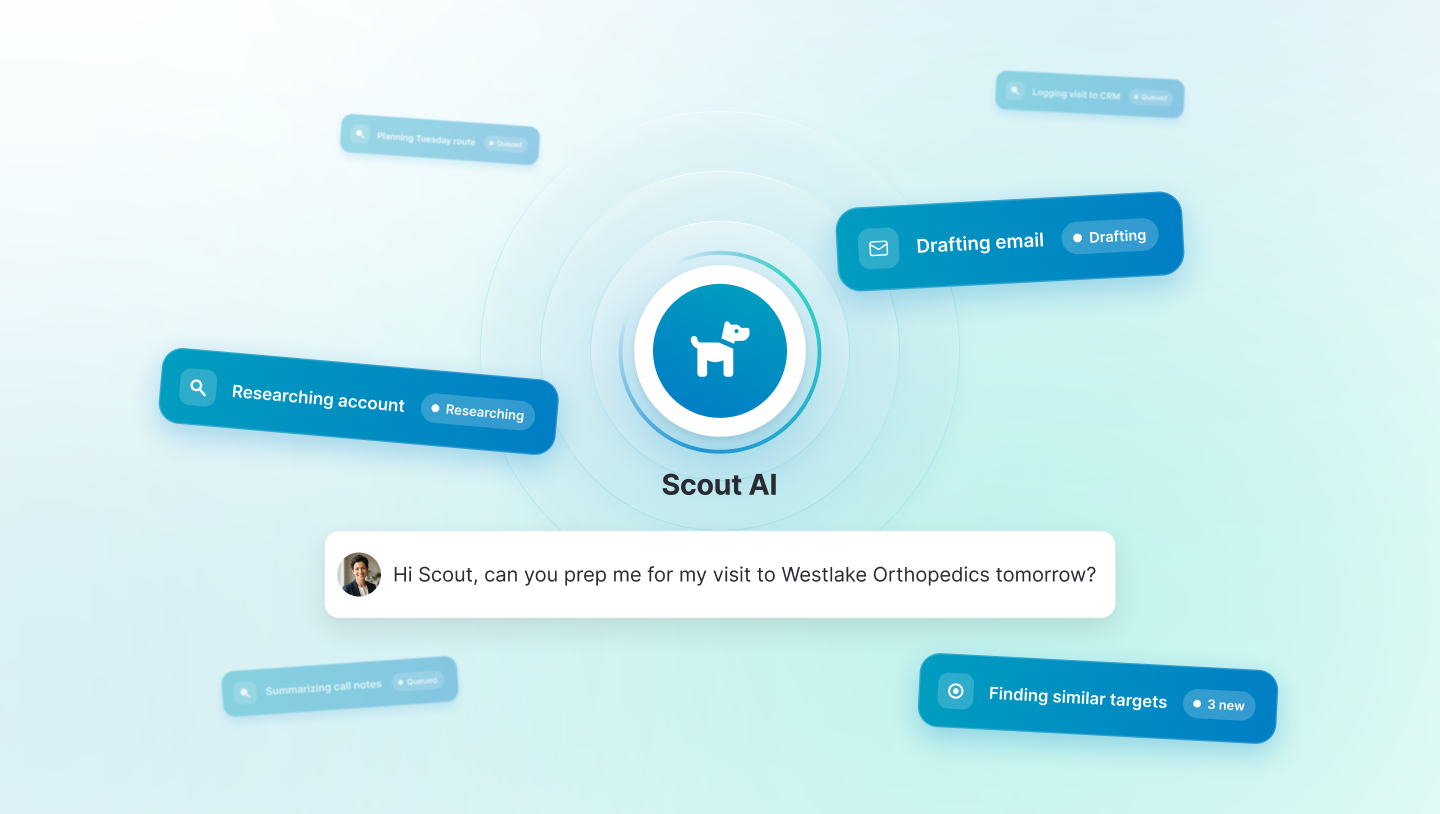
Today, Magnus is one of the first teams to give Claude licenses to its entire commercial org. MedScout maps the patient journey for treatment-resistant depression, and reps use Claude connected to MedScout to shape that data into whatever the meeting calls for. That might be a two-page brief for a first meeting. Later in the cycle, it could be a full pro forma modeling patient capture within a custom radius, based on current patient volume and expected growth.
Omar called out why this matters more in medtech than in SaaS. Field reps spend maybe 20% to 40% of their time selling, and the rest goes to everything else that comes with being full cycle. Asking them to dig through a platform and build a deck by hand never worked well. Matt said the quality of what his team produces has gone up by at least 25% to 30% since they started using Claude this way, and that it has made their messaging more consistent across the team.
Skylar named two patterns from the companies MedScout works with. The first is a commercial leader who treats enablement as their own job and doesn't hand the tooling off to someone else. The second is starting with a few defined use cases. When everyone gets a Claude or ChatGPT Enterprise license at once, it helps to give them a short list of workflows to start with. Marketing builds the template, the template becomes a skill, and the skill goes out to the team. Once that baseline exists, reps can improve on it. Skylar's example was a rep in Chicago who adds a patient pathway that came up in a KOL conversation, and it gets folded back into the shared skill.
Matt advised other sales leaders to pick a partner that can grow with you rather than one that hands over a fixed set of offerings, and not to underestimate how much AI can speed up the business, especially for onboarding and educating a wide customer base. He also suggested having the risk-tolerance conversation with IT early. It was noted that some companies in the space still have a moratorium on tools like Claude and ChatGPT.
On how MedScout has changed over the years: until recently, the goal was the best all-in-one platform, one that got 80% to 90% of the way on the core jobs without much room to customize. Skylar described three things the company is focused on now:
The episode closed on where the field role is headed. At Magnus, launching an account is where the race starts, and the clinical account managers who bring growth insights afterward are what separate companies growing 10% a year from those growing 30% to 50%. Matt also flagged reimbursement: Each new commercial payer changes Magnus' targeting, so the team has to be able to refocus quickly.
Skylar expects reps to go more full cycle, moving up and down the hierarchy from health system to site to individual physician to find patients already in the system. That used to take dedicated headcount most early-stage companies couldn't pay for.
MedTech has long struggled to justify the cost of full-cycle reps compared with industries that split the sales process across two or three roles. Omar believes that AI tools finally make that model sustainable.
Listen to the full episode on State of MedTech.
Watch on YouTube.
To see MedScout insights inside AI platforms like Claude or ChatGPT, you can sign up for the MedScout MCP trial.