All Resources
Insights & Reports
RECAP: 5 takeaways from MedTech sales ops leaders on how they’re using data and AI
In our recent webinar, sales operations and strategy leaders from Glaukos and Sanuwave shared how they use data and AI today.
In our recent webinar, sales operations and strategy leaders from Glaukos and Sanuwave shared how they use data and AI today.
You can watch the full webinar recording here -->
Participants:
Ryan Smith, Head of Business Intelligence and Strategy
Andrew Calcaterra, Senior Sales Operations Analyst, Glaukos
David Rickheim, Manager of Commercial Analytics, Sanuwave
Skylar Talley, Co-founder and CEO, MedScout
Previously, reps sent every request for data and insights through a centralized sales operations team. The team wanted field reps to have insights at their fingertips, both because it leads to better outcomes in the field and because it would free them up for more strategic work.
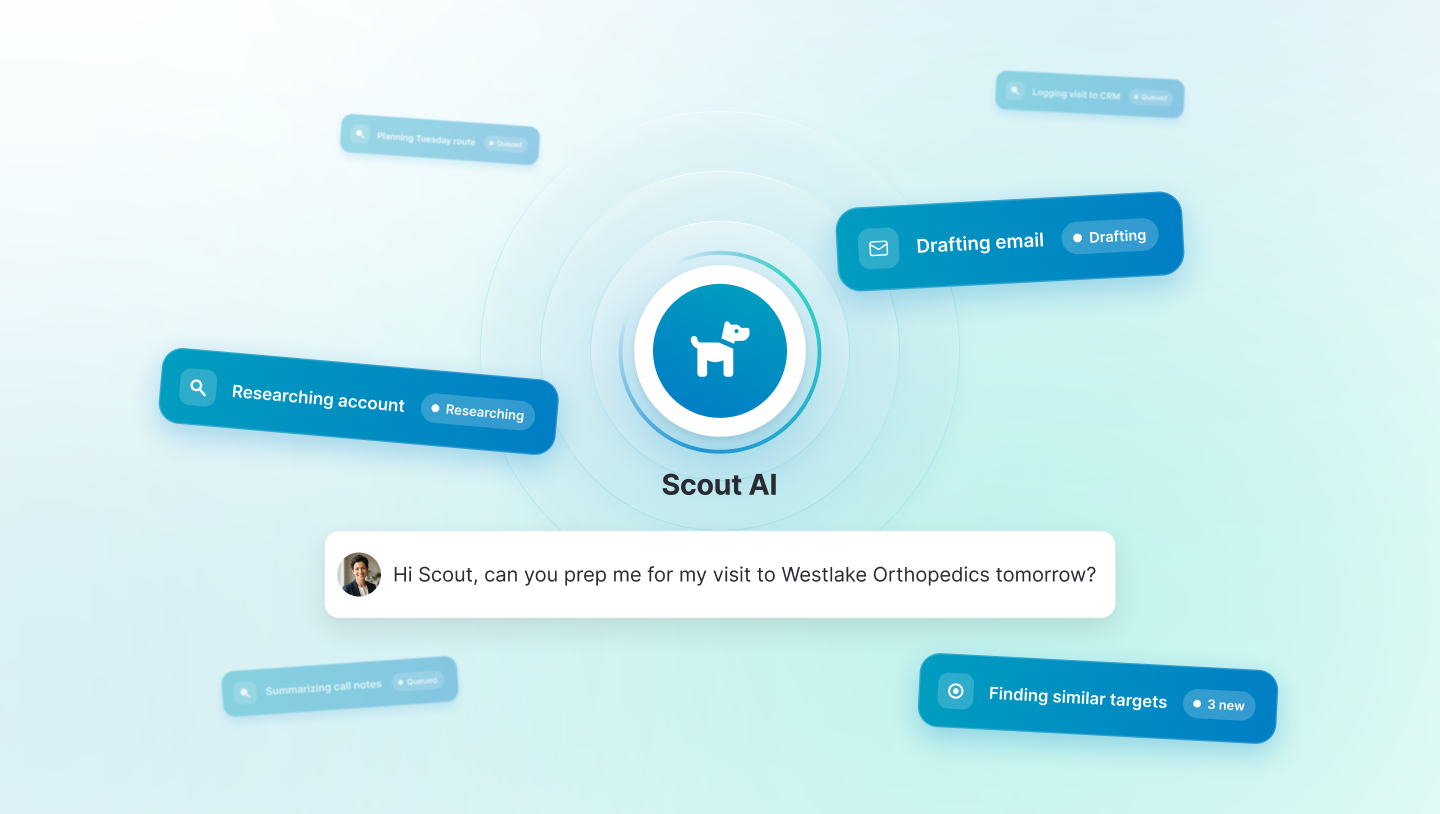
The team built an internal app powered by MedScout and gave their reps access to Scout AI and the MedScout mobile app. Reps now access insights themselves on the fly in a fraction of the time.
Some of the best AI use cases are those that free up your inbox.
"Before AI, everyone was reliant on us to feed them the insights for each individual territory. Now it's easier for the reps to gather those insights themselves."
Andrew Calcaterra - Senior Sales Operations Analyst, Glaukos
Spot the time-consuming, repeatable processes that AI could do with the right guidance. In MedScout, this means giving your reps refreshed opportunities monthly and letting them self-serve insights and talk tracks as needed.
No single dataset tells the whole commercial story.
Glaukos combines MedScout’s insights with its own proprietary data and third-party sources, all hosted in Google Cloud where Claude can work across everything at once.
Having it in one place lets the team catch things a single source might miss, like a payer policy change that’s actually behind volume moving to a competitor. Those connections stay hidden until the data sits together, and catching them early means guiding the field response before it turns into a problem rather than explaining it afterward.
Sanuwave connects Claude to its ERP, CRM, Microsoft Fabric, Power BI, and MedScout, and uses that setup to automate QBRs and pre-call planning. Each report follows a standard format, so a rep names the account, and the rest runs automatically. Fixed inputs from internal data drive the ROI calculations, MedScout fills in market and site-level data, and what used to take an hour or two now takes 10 to 15 minutes.
"You can't get the full picture until you're able to see how one impacts the other."
Ryan Smith - Head of Business Intelligence and Strategy
Choose a time-consuming workflow, define the standard output, and identify which data source feeds each part. Connect your core systems, such as your CRM, ERP, and BI tools, to your AI platform alongside the MedScout MCP.
In MedScout, a skill specific to your company and workflow can ensure you set it up once, and every QBR, ROI presentation, or pre-call plan after that runs the same way.
AI platforms like Claude and ChatGPT are great at working through files, lists, and open-ended questions, but on their own they don’t know the MedTech market.
Hand a generic AI a conference attendee list and it can sort, summarize, or reformat it, but it can’t tell you which names are good-fit targets, where they operate, or why any of them matter. Connect that same AI platform to data and skills built around how MedTech commercial teams actually work, and what comes back is something your team can act on right away, probably with fewer em dashes.
An example was demoed live, dropping a conference attendee list into Claude to identify which surgeons a rep in Dallas should contact first while they're in town for the event.
MedScout + Claude narrowed the list to knee surgeons who operate mostly in ASCs and treat the most BCBS patients. From there, Claude can go a step further, turning that list into a one-page brief for each surgeon or a conference strategy built from your own product messaging.
Ensure you’re using AI that’s fine-tuned to MedTech. If you don’t have MedScout, work with your team to build a few custom skills so that you’re not working from what you get out of a generic LLM.
Territory planning is one of the most time-consuming projects every year, and AI can cut it down significantly. In the webinar example, we used MedScout’s territory optimization to balance territories for 10 reps based on real market activity for an osteoarthritis code set.
Just this portion of territory planning used to take weeks or even months.
Optimization can factor in your current accounts and multiple indications, then be promoted straight into live territories.
Use AI to create territories that balance opportunity evenly across your sales force. That could be based on the number of providers, procedure volume, your own sales data, or any other data source.
Glaukos wanted to solve a very specific problem for its field team, so the team built a lightweight app its reps use by voice from the car. Ask which accounts a new payer coverage decision affects, and the answer comes back on the spot based on MedScout data and additional sources.
Skylar also showed how Scout AI in the MedScout mobile app can find the surgeons the rep should see and build an optimized route based on where they’ll be that day and drive time.
You can watch the full recording here or get a two-week trial of the MedScout MCP. It works with Claude, ChatGPT, Gemini, and Copilot.