Analysis: Robotic joint replacement once grew 10x, but the hypergrowth era is over.
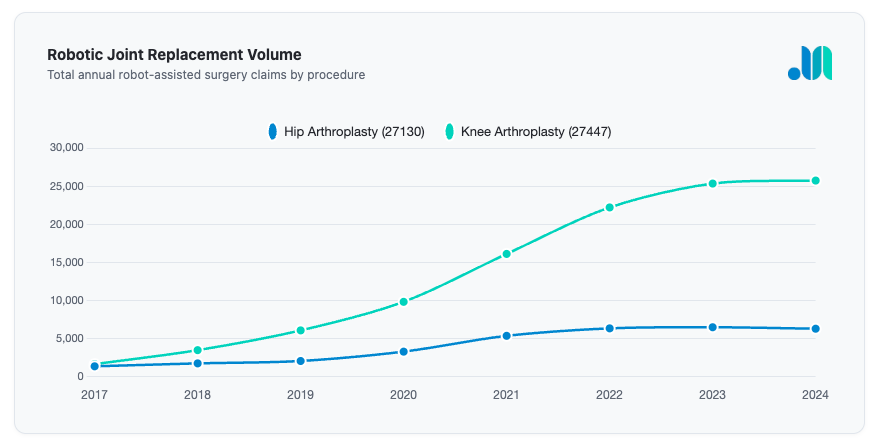
Robotic-assisted hip and knee replacements grew nearly 10x from 2017 to 2024. Growth has slowed, care settings have shifted, and competition looks different.

Robotic-assisted hip and knee replacements grew nearly 10x from 2017 to 2024. Growth has slowed, care settings have shifted, and competition looks different.
Note: This analysis reviewed THA and TKA claims paired with a code indicating robotic system use. Because CMS does not formally require robotic codes for Medicare reimbursement, reporting consistency varies, though providers routinely include them for internal documentation purposes. Treat these figures as directionally accurate, not precise counts. Diving in....
The trajectory of robotic surgery, specifically joint replacement, is one of the cleaner growth arcs in recent medical device history.
Total robotic-assisted hip and knee replacements rose from a combined ~3,000 cases in 2017 to ~32,000 by 2024, according to MedScout data.

But then growth stalled. This doesn’t mean the market is shrinking. We should expect continued, steady growth. But the pace of that growth dropped noticeably by 2023 and 2024. While 100% of 2025 claims are not yet available without making projections, the data looks very similar.
The category is maturing, and data suggests the market is moving into a structurally different phase.

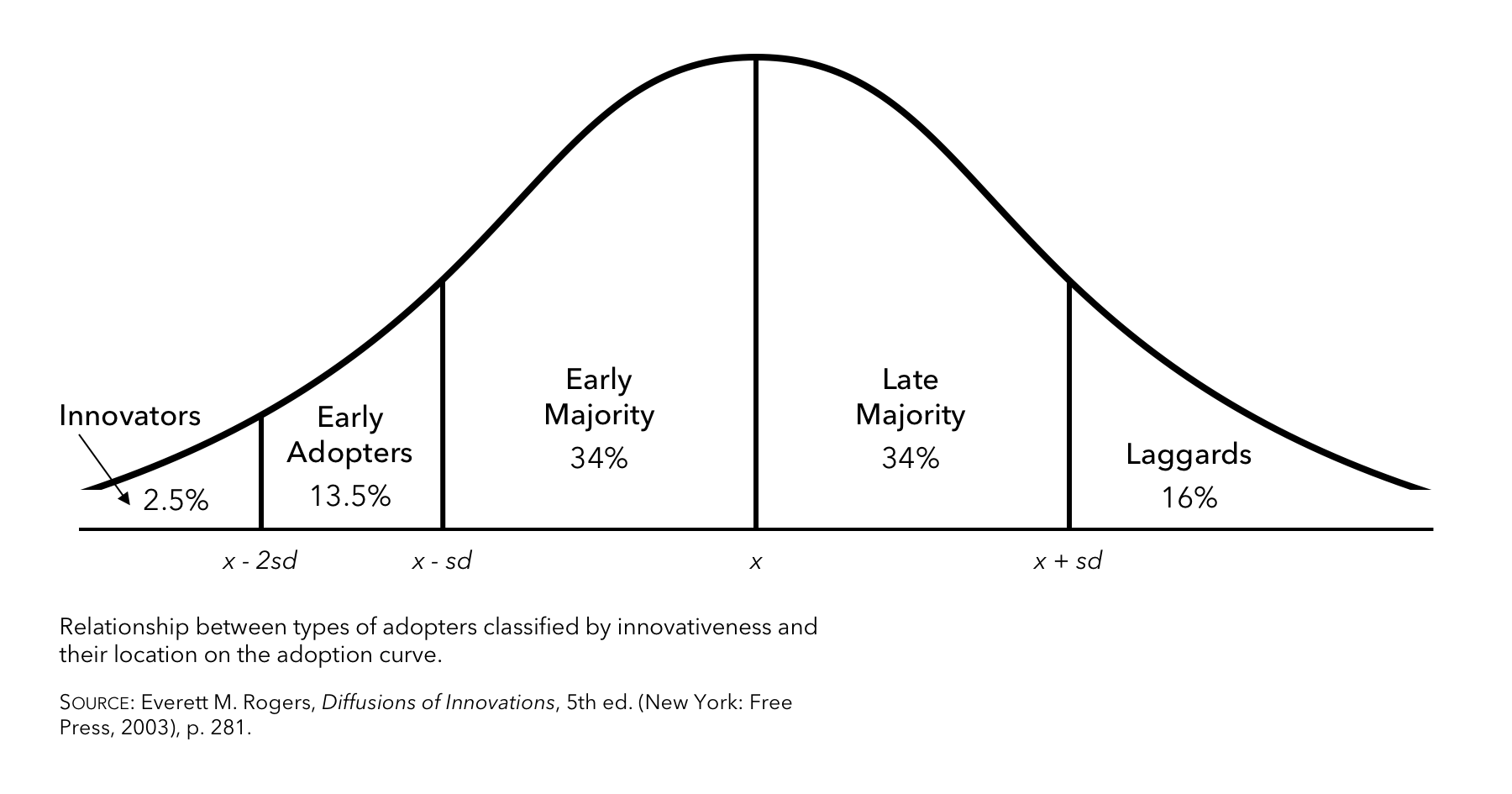
Above is Rogers' Diffusion of Innovations, which has been a useful framework for over 60 years on how new technologies are adopted over time. But it was built for consumer technology.
Medical devices don't follow the same path. Regulation, reimbursement, capital budgets, and surgical training requirements all introduce friction that consumer products never encounter, and a device can have overwhelming clinical evidence and still stall for years waiting on reimbursement approvals.
.png)
We’ve adapted the curve for how healthcare providers actually deploy new medical technology.
Clinical Pioneers take on some risk to establish the earliest proof points.
Standard Setters bring the technology into leading centers of excellence, formalize the technique, and generate broader clinical evidence.
Program Scalers drive rapid expansion within early-adopting hospitals and health systems.
Operational Integrators extend the technology across care settings and operating models within their organizations as it becomes the clinical standard.
Default Followers enter once economics and workflows are standardized, and adoption becomes necessary to remain competitive.
The 2020-2022 period in robotic joint replacement appears to be the Program Scaler phase: rapid expansion within early-adopting institutions, driven by surgeon preference and accumulating clinical evidence.
The 2023 and 2024 data reflect a transition into the Operational Integrators phase, where growth is no longer primarily about new logos but about extending technology across care settings and operating models within systems that have already committed.
That transition matters commercially because it changes what determines competitive positioning. In the Program Scaler phase, you win on clinical differentiation and surgeon relationships. In the Operational Integrators phase, those things still matter. But the competitive variables shift toward deployment friction and economics: footprint, capital efficiency, throughput, training ramp speed, and the ability to function across facility types.
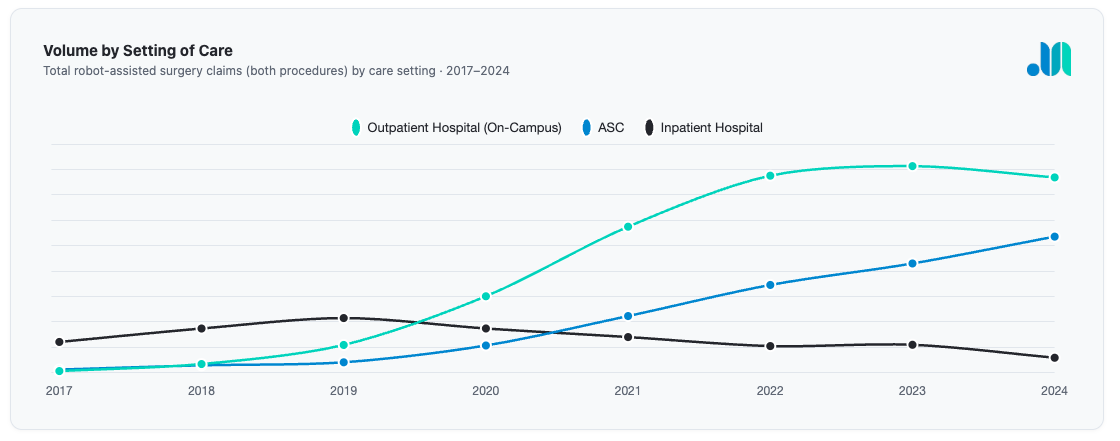
We see that exact pattern when we look into where these surgeries are happening. The site-of-care distribution for robotic joint replacement has shifted greatly over the past seven years.

Inpatient market share went from dominant in 2017 to single digits by 2024. Hospital outpatient initially absorbed most of that volume and remains the primary venue. ASC share has been climbing meaningfully, with every indication that the trend will continue as Medicare policy changes accelerate outpatient migration.
The response from the world's largest medical device companies reflects a similar reading of the data. Smaller footprint, lower deployment friction, and setting-agnostic design have become organizational priorities.
Stryker's Mako RPS, a handheld robotic power system for total knee replacement, is positioned as a lower-complexity path to robotic-assisted surgery, designed for surgeons and facilities where the full Mako platform is impractical. Mako RPS completed its first case in the U.S. in January.
Smith+Nephew reported record CORI placements in its full-year 2025 results, with 45% of new systems being installed in ASCs. CORI is a handheld robotic-assisted surgical platform primarily used for knee replacements.
This market shift also extends beyond orthopedics. Medtronic's Hugo recently received FDA clearance and performed its first surgeries, and the company is touting modularity as a market differentiator. Its newly cleared Stealth AXiS spine robotics system is similarly framed around flexibility across complexity levels and care settings.
Care setting expansion is not a single-company strategic bet. It is the industry-wide thesis for the next phase of growth in robotic surgery.
The Operational Integrators phase we’re now in is also likely to be the most competitive. The install base is no longer wide open, and the facilities easiest to reach have largely been reached. Growth increasingly requires building for more constrained environments, against more entrenched competitors, on the basis of economics as much as clinical performance.
Business model structure will become a meaningful differentiator: capital purchase models that worked in hospital budget cycles don't map cleanly onto ASC decision-making. Per-case pricing, subscription models, and instrument and implant logistics are all variables that will increasingly factor into platform selection. Training ramp speed and workflow standardization across multi-site health system networks will matter in ways they didn't when each placement was effectively a standalone decision.
The market for robotic joint replacement continues to grow. But the growth is coming from care settings and economics that look different from the early years, and the strategies built for the first wave are not automatically suited for the second.
-------
MedScout provides insights into procedures, referrals, patient journeys, and more to help MedTech organizations reach the healthcare providers delivering cutting-edge care to patients.
For questions on the analysis above or to learn more about us, contact us at hello@medscout.io